
Short Answer
Definition of JWST’s Fuel Constraints
The James Webb Space Telescope (JWST) is equipped with a finite amount of fuel designed to sustain its operations for approximately ten years. This limitation is not arbitrary but a carefully calculated aspect of the mission, balancing engineering capabilities, scientific goals, and the harsh realities of space. The fuel primarily supports the telescope’s ability to maintain its precise orbit and orientation, which are critical for its infrared observations of the universe.
JWST’s Unique Orbital Environment
Unlike many previous space telescopes that orbit relatively close to Earth, JWST is stationed at the second Lagrange point (L2), roughly 1.5 million kilometers from Earth. This location offers a gravitationally stable environment, allowing the telescope to maintain a fixed position relative to the Earth and Sun. Such stability is essential for minimizing thermal fluctuations, which could interfere with JWST’s sensitive infrared instruments.
Halo Orbit and Station-Keeping
Despite the relative stability of L2, JWST does not remain stationary. It follows a “halo orbit” around this point, requiring continuous small adjustments to counteract gravitational influences from Earth, the Moon, and the Sun, as well as the persistent pressure from solar radiation. These adjustments, known as station-keeping maneuvers, consume hydrazine fuel to keep the telescope on its intended path and prevent it from drifting into an unusable trajectory.
Fuel Usage and Mission Design Considerations
The fuel onboard JWST serves multiple purposes beyond station-keeping. It is also vital for attitude control, which ensures the telescope maintains the exact orientation needed to capture faint infrared signals from distant cosmic objects. Any misalignment could degrade image quality or cause the telescope to lose track of its targets, compromising years of scientific research.
Engineering Trade-offs and Launch Constraints
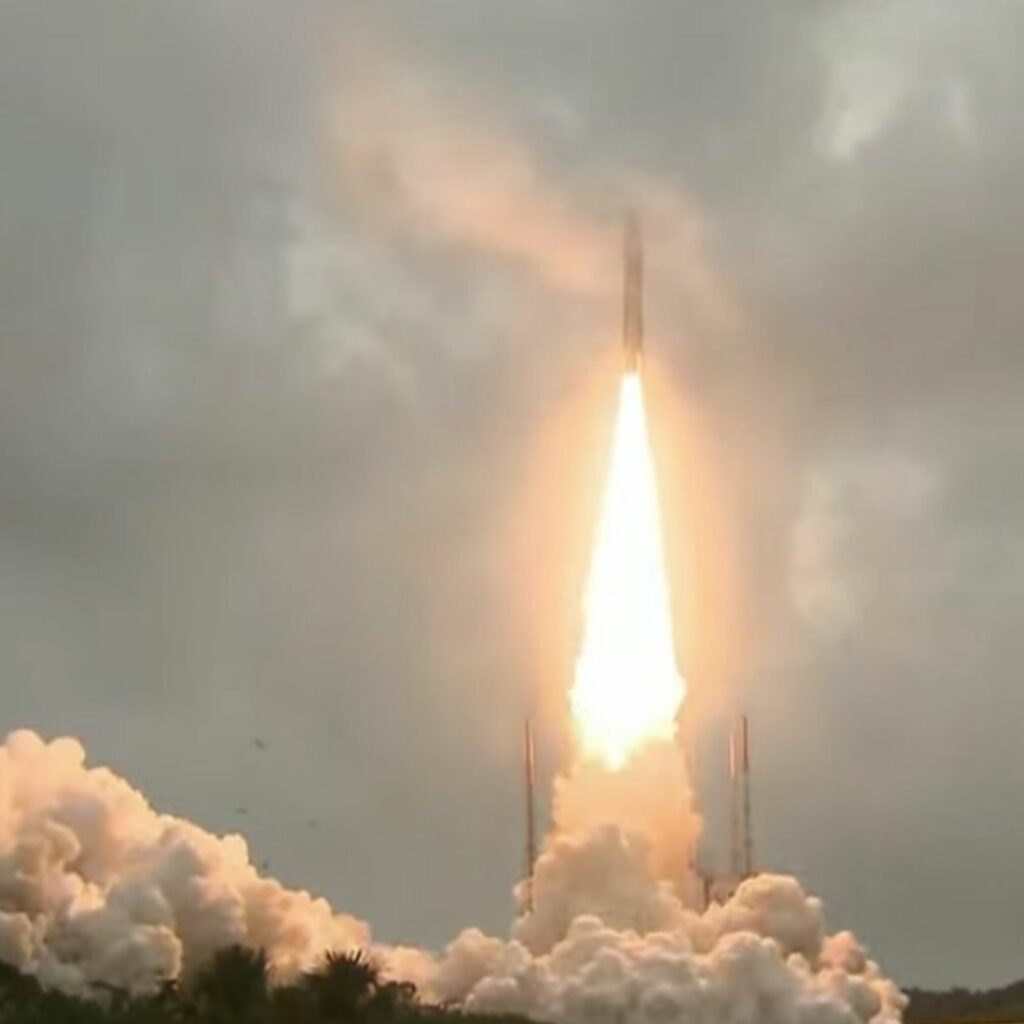
Increasing the fuel load is not a simple solution to extend JWST’s operational life. Additional propellant adds mass, which necessitates stronger structural support and a more powerful launch vehicle, escalating costs and complexity. JWST’s total mass was carefully optimized to fit within the payload capacity of the Ariane 5 rocket, a highly reliable launch system chosen for this mission. This delicate balance between fuel, structural mass, and scientific instruments exemplifies the classic engineering trade-offs in aerospace design.
Alternative Propulsion Methods and Their Limitations
While alternative propulsion technologies such as solar sails or ion thrusters might theoretically extend JWST’s lifespan, they were not selected for this mission due to several constraints. Solar sails can introduce unwanted variations in pointing accuracy, which is detrimental to the telescope’s precise observations. Ion thrusters, although fuel-efficient, require continuous power and complex systems that could disrupt JWST’s critical thermal balance, essential for its infrared detectors.
Energy Management at L2
JWST’s location near L2 offers excellent thermal conditions but also imposes strict energy limitations. The telescope’s power budget prioritizes maintaining its instruments and thermal stability, leaving little room for the additional power demands of advanced propulsion systems. Consequently, the mission relies on proven hydrazine thrusters for maneuvering, balancing reliability with operational efficiency.
Impact of Unforeseen Events on Fuel Consumption
Unexpected occurrences such as micrometeoroid impacts or hardware anomalies can necessitate extra maneuvers to stabilize or realign the telescope. These events increase fuel consumption, underscoring the importance of maintaining a fuel reserve that is neither excessive nor insufficient. Mission planners must carefully monitor fuel usage and optimize maneuvers to extend JWST’s operational life as much as possible.
Strategic Mission Planning and Fuel Efficiency
The finite fuel supply drives innovation in how the mission is planned and executed. Scientists and engineers must prioritize observations and schedule activities to maximize scientific output while conserving propellant. This involves optimizing trajectory corrections and fine-tuning attitude control to minimize unnecessary fuel expenditure, ensuring the telescope remains functional for the longest feasible period.
Significance of JWST’s Fuel Limitations
The ten-year fuel capacity of JWST represents a sophisticated compromise between engineering feasibility, budget constraints, and scientific ambition. Far from being a drawback, this limitation encourages meticulous planning and resourcefulness, pushing the boundaries of what can be achieved within finite means. It highlights the intricate interplay of physics, technology, and mission design that defines modern space exploration.
JWST’s Legacy and the Future of Space Observation
As JWST continues to explore the cosmos-shedding light on star formation, galaxy evolution, and the atmospheres of distant exoplanets-the finite fuel supply adds a sense of urgency to its mission. Each moment of observation is precious, and every gram of hydrazine is invaluable. How humanity manages this resource will influence the trajectory of astronomical discovery and space exploration for years to come.




Leave a Reply