
Short Answer
Overview of the Standard Model in Particle Physics
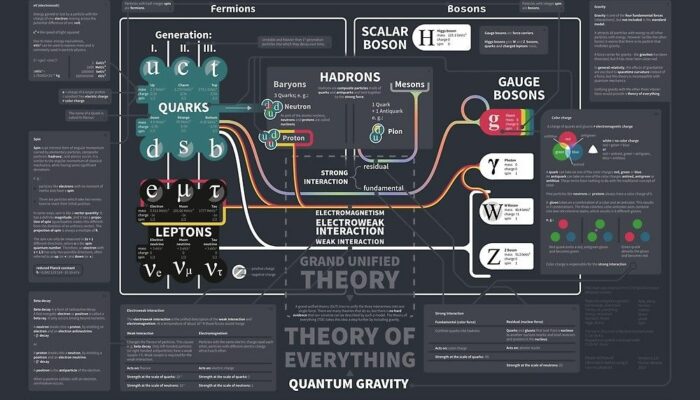
The Standard Model represents a cornerstone in modern physics, providing a comprehensive framework that describes the fundamental particles and their interactions. This theoretical construct, supported by extensive experimental validation, successfully explains the behavior of elementary particles such as quarks, leptons, and gauge bosons. Despite its profound achievements, the Standard Model remains an incomplete theory, leaving several critical questions unanswered and prompting the search for new physics beyond its boundaries.
Limitations and Unresolved Issues
While the Standard Model has been remarkably effective, it fails to account for several key phenomena observed in the universe. These include:
- Dark Matter:
The model does not explain the nature of dark matter, which constitutes a significant portion of the universe’s mass but interacts weakly with ordinary matter. - Neutrino Masses:
Neutrinos are known to have mass, yet the Standard Model originally predicted them to be massless, indicating a gap in the theory. - Matter-Antimatter Asymmetry:
The observed dominance of matter over antimatter in the universe is not fully explained by the Standard Model’s mechanisms.
Emerging Theoretical Frameworks
To address these shortcomings, physicists have proposed several innovative theories that extend or modify the Standard Model:
- Supersymmetry (SUSY):
This theory posits a symmetry between fermions and bosons, predicting a partner particle for each known particle, potentially solving issues like dark matter candidates. - Extra-Dimensional Theories:
These suggest the existence of additional spatial dimensions beyond the familiar three, which could influence particle interactions and fundamental forces. - String Theory:
A framework where particles are modeled as one-dimensional strings, offering a unified description of all forces, including gravity.
Experimental Efforts and Technological Advances
Cutting-edge experiments play a crucial role in testing these new theories and searching for phenomena beyond the Standard Model:
- High-Energy Colliders:
Facilities like the Large Hadron Collider (LHC) and its planned upgrades enable particle collisions at unprecedented energies, increasing the chances of discovering new particles. - Precision Measurements:
Experiments focusing on subtle effects and rare processes help refine theoretical predictions and identify deviations indicating new physics. - Neutrino Observatories:
Specialized detectors study neutrino properties and interactions, shedding light on their masses and oscillations.
Interconnection with Cosmology and Astrophysics
The relationship between particle physics and cosmology is deeply intertwined, as observations of the universe provide complementary insights:
- Cosmic Microwave Background (CMB):
Measurements of the CMB radiation offer clues about the early universe and the behavior of fundamental particles shortly after the Big Bang. - Large-Scale Structure:
The distribution of galaxies and dark matter informs models of particle interactions and the evolution of cosmic matter.
Unification of Fundamental Forces
A major goal in theoretical physics is to unify the four fundamental forces-electromagnetic, weak, strong, and gravitational-into a single coherent framework. This endeavor involves:
- Quantum Gravity Theories:
Approaches such as loop quantum gravity attempt to reconcile quantum mechanics with general relativity. - Grand Unified Theories (GUTs):
These propose that at high energies, the electromagnetic, weak, and strong forces merge into one force.
Dark Matter: Candidates and Detection Strategies
Dark matter remains one of the most enigmatic components of the cosmos. Several hypothetical particles have been proposed as candidates:
- WIMPs (Weakly Interacting Massive Particles):
These particles interact via the weak nuclear force and gravity, making them difficult to detect. - Axions:
Light particles predicted by certain extensions of the Standard Model, potentially solving the strong CP problem. - Sterile Neutrinos:
Hypothetical neutrinos that do not interact via the standard weak force, possibly contributing to dark matter.
Detection methods include underground direct detection experiments, which aim to observe rare interactions with ordinary matter, and indirect searches that look for signals from dark matter annihilation or decay in space.
Innovative and Alternative Concepts
Beyond mainstream theories, particle physics research explores unconventional ideas that challenge established paradigms:
- Hidden Sectors:
Hypothetical collections of particles that interact weakly with the Standard Model, potentially explaining dark matter and other anomalies. - Dark Photons:
Proposed force carriers analogous to photons but operating within hidden sectors. - Non-Standard Neutrino Interactions:
Extensions to neutrino physics that could reveal new forces or particles.
The Human and Technological Dimension of Particle Physics
Particle physics is not only a theoretical and experimental pursuit but also a testament to international collaboration and technological innovation. Large-scale experiments involve thousands of scientists worldwide, leveraging advances in detector technology, computational algorithms, and data analysis to push the boundaries of knowledge.
Implications and Future Prospects
Discoveries beyond the Standard Model have the potential to revolutionize our understanding of the universe, influencing fields such as materials science, quantum computing, and even philosophy. The ongoing quest promises to reshape fundamental physics and inspire new technological breakthroughs.
Summary: The Next Frontier in Particle Physics
The future of particle physics is defined by a complex interplay of themes: the search for new particles, efforts to unify fundamental forces, the mysteries of dark matter and neutrinos, and the integration of cosmological data. This dynamic field continues to evolve, driven by curiosity and innovation, poised to redefine our grasp of the universe’s most basic elements.





Leave a Reply