
Short Answer
Definition of Exoplanetary Visible Light Detection
Exoplanetary visible light detection refers to the direct observation and analysis of light emitted or reflected by planets orbiting stars beyond our solar system. This breakthrough enables scientists to study the atmospheric properties and surface conditions of these distant worlds by capturing their visible light spectra, providing critical insights into their composition, structure, and potential habitability.
Background and Significance of Exoplanet Research
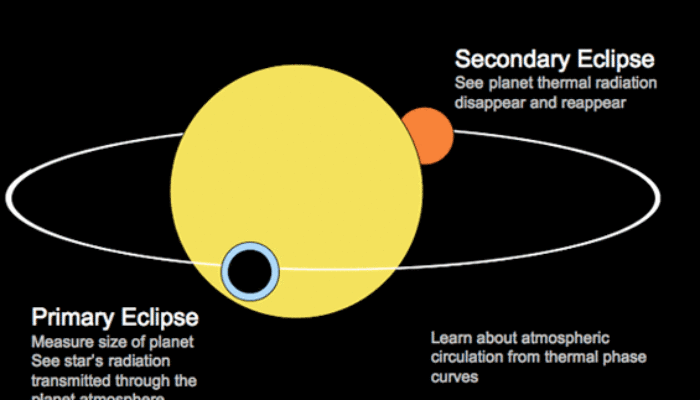
Exoplanets, defined as planets orbiting stars other than the Sun, have fascinated astronomers since their first confirmed discovery in the 1990s. To date, thousands of these celestial bodies have been identified, each exhibiting diverse characteristics. While indirect detection methods such as transit photometry and radial velocity have dominated the field, the direct capture of visible light from an exoplanet represents a monumental advancement. This capability opens a new observational window into the physical and chemical processes occurring on these remote planets, moving beyond mere detection to detailed characterization.
Principles of Spectroscopic Analysis in Exoplanet Studies
Spectroscopy plays a pivotal role in the direct detection of exoplanet light. By dispersing the incoming light into its component wavelengths, astronomers can decode the unique spectral signatures that reveal the presence of various atmospheric gases and compounds. This technique functions like a cosmic fingerprint, allowing researchers to identify molecules such as water vapor, methane, and oxygen, which are essential indicators of atmospheric composition and potential biological activity.
How Spectroscopy Works
- Light Dispersion:
Incoming light from an exoplanet is separated into a spectrum of colors or wavelengths. - Molecular Absorption:
Specific molecules absorb light at characteristic wavelengths, creating identifiable absorption lines. - Data Interpretation:
Analysis of these absorption features enables determination of atmospheric constituents and physical conditions.
Historical Context and Evolution of Light Studies in Astronomy
The study of light has been foundational to physics and astronomy for centuries, from Newton’s prism experiments to modern astrophysical spectroscopy. The recent ability to detect visible light directly from exoplanets builds upon this legacy, offering unprecedented insights into planetary atmospheres beyond our solar system. This progress challenges existing models of planetary formation and atmospheric evolution, prompting a reevaluation of how diverse planetary environments develop over time.
Implications for Astrobiology and the Search for Life
The detection of visible light spectra from exoplanets is particularly exciting for astrobiology, as it allows scientists to search for biomarkers-molecules that may indicate biological processes. Identifying organic compounds or gases like oxygen and methane in an exoplanet’s atmosphere could suggest the presence of life or prebiotic conditions, fueling the quest to understand whether life exists elsewhere in the universe.
Technological Innovations Enabling Exoplanet Light Detection
Advanced observational tools are critical to overcoming the challenges posed by the overwhelming brightness of host stars, which often outshine their orbiting planets. Technologies such as high-contrast imaging, adaptive optics, and space-based telescopes have been instrumental in isolating the faint light emitted or reflected by exoplanets. Continued development of these instruments promises to enhance the resolution and sensitivity of future observations.
Key Technologies
- High-Contrast Imaging:
Techniques that suppress starlight to reveal nearby faint objects. - Adaptive Optics:
Systems that correct atmospheric distortions in real-time for clearer images. - Space Telescopes:
Observatories positioned beyond Earth’s atmosphere to avoid atmospheric interference.
Broader Scientific and Philosophical Ramifications
The ability to study exoplanet light extends beyond astrophysics, influencing fields such as evolutionary biology, planetary science, and ethics. Discovering organic molecules or signs of life would prompt profound questions about humanity’s role in the cosmos, planetary stewardship, and the ethical considerations of interstellar exploration. Moreover, understanding the interactions between stars and their planets sheds light on the dynamics shaping entire solar systems.
Applications Beyond Astronomy
The technological advancements developed for exoplanet light detection have far-reaching applications. Innovations in imaging and spectroscopy can be adapted for use in materials science, telecommunications, and medical diagnostics, demonstrating the interdisciplinary benefits of astronomical research.
Conclusion: The Transformative Impact of Visible Light Detection from Exoplanets
The first direct observation of visible light from an exoplanet marks a pivotal milestone in humanity’s quest to comprehend our cosmic environment. This achievement embodies the fusion of curiosity, technological innovation, and scientific rigor, opening new frontiers for exploration and understanding. As research progresses, it will not only deepen our knowledge of distant worlds but also inspire reflection on our place in the universe and the shared destiny of life across the stars.
FAQ
What is the significance of detecting visible light from exoplanets?
Detecting visible light allows scientists to study the atmospheric properties and potential habitability of exoplanets, providing insights into their composition and the possibility of life.
How does spectroscopy aid in the study of exoplanets?
Spectroscopy enables astronomers to analyze the spectrum of light from exoplanets, identifying atmospheric gases and compounds that indicate potential biological activity.


Leave a Reply