
Short Answer
Definition of Axions
Axions are hypothetical elementary particles proposed to address unresolved issues within particle physics and cosmology. Initially introduced to solve a specific symmetry problem in the Standard Model, axions have since gained prominence as potential candidates for dark matter, the mysterious substance that constitutes the majority of the universe’s mass but remains invisible to direct observation.
- Origin:
Axions were theorized to resolve the strong CP (Charge Parity) problem, an unexpected symmetry violation in the strong nuclear force. - Dark Matter Candidate:
Due to their predicted properties, axions are considered promising constituents of dark matter, which influences cosmic structure through gravity but does not interact with light.
Historical Context and Theoretical Background
The concept of axions emerged from efforts to reconcile an anomaly in the Standard Model of particle physics. Researchers noticed that the strong nuclear force, which binds quarks inside protons and neutrons, exhibited an unexpected symmetry behavior that contradicted theoretical expectations. To “clean up” this inconsistency, theorists introduced a new particle, whimsically named after a detergent brand, symbolizing its role in tidying the theory.
Beyond this initial motivation, axions have become central to modern physics due to their potential to explain dark matter. Unlike ordinary matter, dark matter does not emit, absorb, or reflect light, making it detectable only through gravitational effects on visible matter, radiation, and the large-scale structure of the universe.
Physical Properties and Expected Behavior
Axions are predicted to be extremely light particles, with masses many orders of magnitude smaller than that of electrons. Their weak interactions with ordinary matter and electromagnetic radiation make them extraordinarily difficult to detect. These properties influence how axions might manifest in experimental settings and astrophysical observations.
- Mass:
Expected to be minuscule, influencing their interaction strength and detection methods. - Interactions:
Axions may convert into photons under strong magnetic fields, a principle exploited in many detection experiments.
Experimental Approaches to Axion Detection
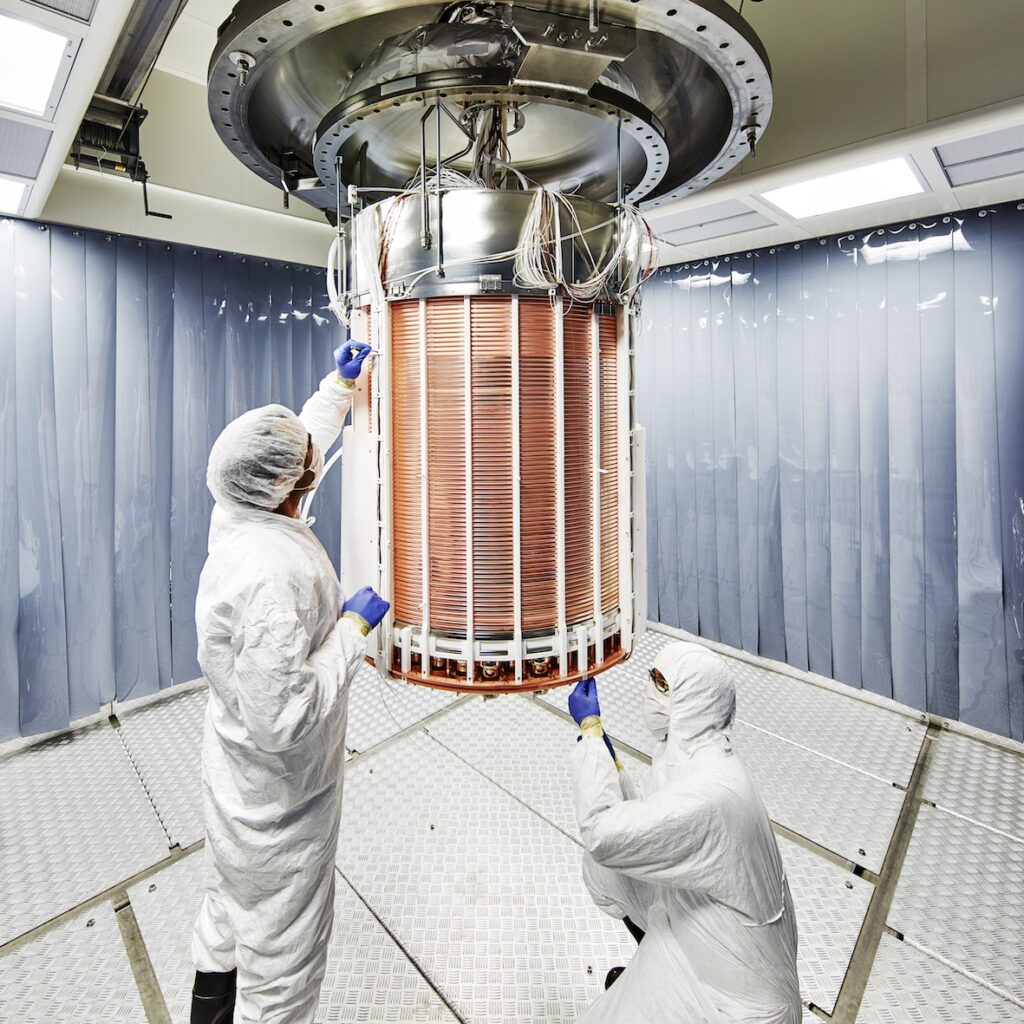
Detecting axions requires highly sensitive and innovative experimental setups due to their elusive nature. Researchers employ various techniques, often conducted in underground laboratories to minimize interference from cosmic rays and environmental noise.
- Resonant Microwave Cavities:
These devices aim to convert axions into detectable photons by exploiting their interaction with magnetic fields. - Liquid Xenon Detectors:
Ultra-pure liquid xenon, cooled to cryogenic temperatures, serves as a medium where axion-like particles might interact, producing rare photons or electrons that signal their presence. - Magnetic Field Experiments:
Controlled environments with strong magnetic fields are used to stimulate axion-photon conversion, enhancing detection prospects.
Theoretical and Astrophysical Constraints
The search for axions is guided by ongoing theoretical developments and astrophysical observations. Quantum chromodynamics (QCD), cosmology, and stellar physics provide indirect evidence and constraints on axion properties.
- Stellar Cooling:
Observations of how stars lose energy help limit the possible interactions and masses of axions. - Neutron Star Behavior:
The dynamics of neutron stars offer additional clues, refining the parameter space where axions might exist.
Significance of Axion Discovery
Uncovering axions would represent a monumental breakthrough in physics, simultaneously addressing two profound mysteries: the strong CP problem and the nature of dark matter. Such a discovery would unify disparate areas of particle physics and cosmology, potentially reshaping our understanding of the universe’s fundamental structure.
Moreover, the implications extend beyond theoretical physics. Insights into axions could spur advancements in quantum computing, precision measurement technologies, and even futuristic propulsion concepts, highlighting the particle’s broad scientific and technological relevance.
Challenges and Ongoing Research
Despite decades of dedicated research and increasingly sophisticated experiments, axions remain undetected. This persistent elusiveness fuels continuous innovation in experimental design and theoretical modeling, reflecting the iterative nature of scientific progress.
The quest for axions exemplifies humanity’s relentless curiosity and ingenuity, pushing the boundaries of technology and knowledge in pursuit of understanding the universe’s hidden symmetries and forces.
Common Misconceptions About Axions
Axions are just theoretical constructs with no practical significance.
While theoretical, axions have profound implications for explaining dark matter and fundamental symmetries, with potential technological applications.
Axions can be easily detected with current technology.
Their extremely weak interactions and tiny mass make axions extraordinarily difficult to detect, requiring highly sensitive and specialized instruments.
Future Prospects and the Path Forward
The ongoing pursuit of axions continues to inspire new experimental techniques and theoretical insights. Each incremental advance brings the scientific community closer to potentially confirming their existence, which would revolutionize physics and cosmology.
As research progresses, the discovery of axions could transform our understanding of the cosmos, revealing the intricate fabric of reality and the unseen forces shaping it. Until then, the search remains a testament to scientific perseverance and the enduring human quest for knowledge.
FAQ
What are axions?
Axions are hypothetical elementary particles suggested to resolve issues in particle physics and are considered candidates for dark matter.
Why are axions important?
Axions could solve the strong CP problem and help explain the nature of dark matter, impacting both theoretical physics and practical technology.
How are axions detected?
Detecting axions involves sensitive experiments, such as resonant microwave cavities and liquid xenon detectors, to convert axions into detectable photons.




Leave a Reply