
Short Answer
Definition of Gravitational Lensing
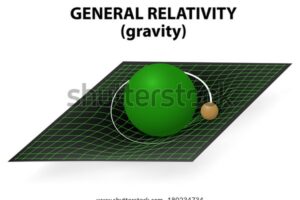
Gravitational lensing is a natural astrophysical phenomenon where the gravitational field of a massive object, such as a galaxy or galaxy cluster, bends the trajectory of light emitted from a more distant source. This effect arises from the curvature of spacetime caused by mass, as described by Einstein’s general theory of relativity. Instead of traveling in straight lines, light rays follow curved paths around massive bodies, resulting in magnified, distorted, or multiple images of the background objects.
- Massive Objects as Lenses:
Objects with significant mass warp spacetime, causing light to bend around them. - Observable Effects:
The bending can produce arcs, rings, or multiple images of distant galaxies or quasars. - Cosmic Magnification:
Acts like a natural telescope, enhancing the visibility of otherwise faint or hidden celestial bodies.
Mechanism Behind Gravitational Lensing
The underlying principle of gravitational lensing is the distortion of spacetime geometry by mass. According to general relativity, mass and energy tell spacetime how to curve, and curved spacetime tells light how to move. When light from a distant source passes near a massive foreground object, its path bends, altering the apparent position and shape of the source as seen by an observer.
This bending can be categorized into three main regimes:
- Strong Lensing: Produces highly visible distortions such as arcs, Einstein rings, and multiple images of a single source.
- Weak Lensing: Causes subtle shape changes in background galaxies, detectable only through statistical analysis of large samples.
- Microlensing: Occurs when compact objects like black holes or rogue planets temporarily magnify the brightness of background stars as they pass in front.
Mathematical Framework and Formulas
The deflection angle of light due to gravitational lensing can be approximated by the formula:
α = (4GM) / (c²b)
- α (Deflection Angle): The angle by which light is bent.
- G (Gravitational Constant): Universal constant governing gravitational force.
- M (Mass of Lens): Mass of the intervening object causing the lensing effect.
- c (Speed of Light): Constant speed at which light travels in vacuum.
- b (Impact Parameter): The closest approach distance of the light to the lensing mass.
More complex lensing scenarios require solving the lens equation, which relates the positions of the source, lens, and image, often involving numerical methods for realistic mass distributions.
Applications in Cosmology and Astrophysics
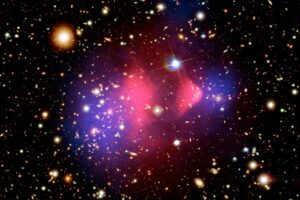
Gravitational lensing serves as a critical observational tool in modern cosmology, enabling the study of mass distributions that are otherwise invisible, such as dark matter. Since dark matter does not emit or absorb light, its presence is inferred through its gravitational effects on light from background sources.
- Mapping Dark Matter: By analyzing lensing-induced distortions, astronomers can reconstruct the spatial distribution of dark matter across cosmic scales.
- Probing Dark Energy: Lensing measurements help track the growth of cosmic structures over time, providing insights into the mysterious dark energy driving the universe’s accelerated expansion.
- Studying Early Galaxies: Lensing magnifies distant, young galaxies, allowing detailed observations of their formation, star formation rates, and chemical properties.
Data Collection and Technological Advances
Large-scale sky surveys and advanced telescopes have been instrumental in gathering gravitational lensing data. Instruments like the Hubble Space Telescope have captured iconic images of lensing phenomena, revealing galaxies billions of light-years away whose light paths have been warped en route to Earth.
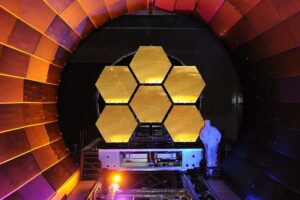
Modern observatories equipped with sensitive CCD cameras and spectroscopic instruments continue to expand the dataset, while upcoming facilities such as the James Webb Space Telescope and the Vera C. Rubin Observatory promise unprecedented resolution and depth.
Computational Challenges and Analytical Techniques
Interpreting gravitational lensing data involves overcoming significant computational hurdles. The vast volume of imaging data requires sophisticated algorithms and machine learning methods to detect subtle lensing signals amidst noise caused by atmospheric effects, instrumental imperfections, and intrinsic galaxy shapes.
Researchers employ statistical modeling to disentangle overlapping lensing effects and to reconstruct accurate mass maps. Cross-correlation with complementary datasets, including cosmic microwave background measurements and galaxy redshift surveys, enhances the reliability of these reconstructions.
Common Misconceptions About Gravitational Lensing
Gravitational lensing is just an optical illusion.
It is a real physical effect caused by the curvature of spacetime due to mass, not merely a trick of light or perspective.
Only visible matter causes lensing.
Both visible and invisible mass, including dark matter, contribute to gravitational lensing effects.
Lensing always produces multiple images.
Depending on the mass and alignment, lensing can cause subtle distortions without multiple images, especially in the weak lensing regime.
Significance of Gravitational Lensing in Modern Science
Gravitational lensing is a cornerstone of contemporary astrophysics and cosmology. It provides a unique window into the invisible components of the universe, such as dark matter and dark energy, which shape cosmic evolution. By enabling the study of distant and faint objects, lensing enriches our understanding of galaxy formation and the large-scale structure of the cosmos.
Moreover, gravitational lensing exemplifies the profound interplay between theoretical physics and observational astronomy, demonstrating how abstract concepts like spacetime curvature manifest in observable phenomena. As technology advances, gravitational lensing will continue to illuminate the universe’s hidden architecture and deepen our comprehension of its fundamental nature.
FAQ
What is gravitational lensing?
Gravitational lensing is a phenomenon where a massive object bends the light from a more distant source, allowing astronomers to study objects that are otherwise too faint to see.
How does gravitational lensing help in understanding dark matter?
By analyzing the distortions of light caused by gravitational lensing, astronomers can infer the presence and distribution of dark matter, which does not emit light.
What types of gravitational lensing are there?
There are three main types: strong lensing, weak lensing, and microlensing, each characterized by the extent of light distortion and the mass of the lensing object.

Leave a Reply