
Short Answer
Overview of the Standard Model in Particle Physics
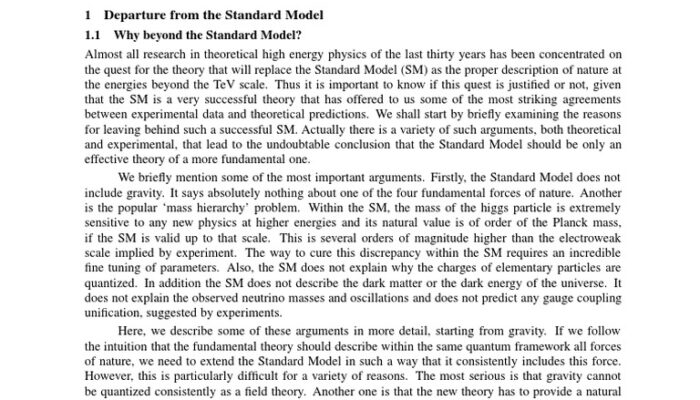
The Standard Model stands as the cornerstone theoretical framework in particle physics, meticulously describing the fundamental particles and the forces that govern their interactions. It integrates three of the four known fundamental forces: electromagnetic, weak, and strong interactions. Over decades, this model has successfully predicted a wide array of particle behaviors and experimental outcomes, solidifying its status as a pivotal scientific achievement. Nevertheless, despite its successes, the Standard Model faces significant challenges and limitations, prompting ongoing efforts to develop a more encompassing theory that can explain phenomena beyond its current scope.
Understanding Supersymmetry (SUSY)
Definition and Core Concept
Supersymmetry, commonly abbreviated as SUSY, is a theoretical extension of the Standard Model proposing a fundamental symmetry between two classes of particles: fermions and bosons. According to SUSY, every known particle has a corresponding “superpartner” whose spin differs by half a unit. This symmetry aims to unify these particle classes and address several unresolved issues within the Standard Model.
- Fermions and Bosons:
Fermions are particles that constitute matter, such as quarks and leptons, while bosons are force carriers like photons and gluons. SUSY links these two by pairing each fermion with a bosonic superpartner and vice versa. - Superpartners:
These hypothetical particles have yet to be observed experimentally but are predicted to exist at higher energy scales.
Addressing the Hierarchy Problem
One of the most compelling motivations for supersymmetry is its potential to resolve the hierarchy problem. This problem arises because the Higgs boson’s mass is unexpectedly light compared to the Planck scale, where gravitational effects become significant. Without a mechanism to stabilize this mass, quantum corrections would drive it to much higher values. SUSY introduces superpartners that counterbalance these corrections, thereby naturally maintaining the Higgs boson’s relatively low mass.
Supersymmetry and Dark Matter
Dark matter, which constitutes roughly 27% of the universe’s total mass-energy content, remains one of the most profound mysteries in cosmology and particle physics. The Standard Model does not provide a viable candidate for dark matter particles, leaving a significant gap in our understanding of the universe’s composition.
- Neutralino as a Dark Matter Candidate:
Within SUSY frameworks, the lightest superpartner, often theorized to be the neutralino, emerges as a promising dark matter candidate. This particle is stable, electrically neutral, and interacts weakly with ordinary matter, aligning well with observed dark matter properties. - Implications for Cosmology:
If supersymmetric particles exist, they could explain the dark matter abundance and influence the evolution of cosmic structures.
Experimental Searches for Supersymmetry
Large-scale particle accelerators, particularly the Large Hadron Collider (LHC), have been at the forefront of probing the existence of supersymmetric particles. By colliding protons at unprecedented energies, the LHC explores energy regimes where SUSY particles might manifest.
- Current Status:
Despite extensive searches, no conclusive evidence for superpartners has been detected to date. - Energy Scale Considerations:
The absence of SUSY signals at the LHC suggests that if supersymmetry exists, it may be realized at energy scales beyond the collider’s current reach.
Philosophical and Scientific Implications of SUSY Research
The ongoing investigation into supersymmetry transcends mere particle detection, touching upon deeper philosophical questions about the nature of scientific theories and empirical validation. The pursuit of physics beyond the Standard Model challenges the boundaries between theoretical predictions and experimental confirmation, highlighting the evolving nature of scientific knowledge.
- Scientific Proof and Limitations:
The difficulty in experimentally verifying SUSY underscores the complexities inherent in confirming theories that operate at extreme energy scales. - Philosophical Reflections:
SUSY embodies a broader narrative of symmetry and harmony in nature, inviting reconsideration of the fundamental principles that underpin physical reality.
Potential Impact of Supersymmetry on Particle Physics
Should supersymmetry be experimentally confirmed, it would herald a paradigm shift in particle physics, prompting a comprehensive reevaluation of established theories and fostering a more unified understanding of the universe’s fundamental forces and constituents.
- Scientific Renaissance:
Discovery of SUSY particles would invigorate theoretical and experimental research, potentially leading to breakthroughs in unifying quantum mechanics with gravity. - Alternative Scenarios:
Conversely, continued non-detection may compel physicists to explore new models and frameworks beyond both the Standard Model and supersymmetry.
Emerging Anomalies and Theories Beyond the Standard Model
Recent experimental observations have revealed subtle discrepancies, often referred to as “tensions,” between predicted and measured particle behaviors. For example, anomalies in B-meson decay rates have sparked interest in new physics that could align with supersymmetric principles or other beyond-Standard Model theories.
- B-Meson Decay Anomalies:
Deviations from expected decay patterns suggest potential new interactions or particles not accounted for in the Standard Model. - Theoretical Interpretations:
These anomalies provide fertile ground for testing supersymmetry and alternative hypotheses, driving the evolution of particle physics.
Conclusion: The Quest for a Unified Understanding
The discourse surrounding supersymmetry epitomizes the scientific endeavor to transcend the limitations of the Standard Model and achieve a more profound comprehension of the universe’s fundamental workings. This pursuit intertwines rigorous empirical investigation with philosophical inquiry, reflecting humanity’s enduring fascination with the cosmos. Whether supersymmetry ultimately proves to be a cornerstone of new physics or a stepping stone toward other theories, its exploration enriches our understanding of the intricate and interconnected nature of reality.
FAQ
What is supersymmetry?
Supersymmetry is a theoretical extension of the Standard Model that proposes a symmetry between fermions and bosons, suggesting every particle has a superpartner.
How does supersymmetry address the hierarchy problem?
Supersymmetry introduces superpartners that help stabilize the Higgs boson's mass against quantum corrections, addressing the hierarchy problem.
What is the significance of dark matter in relation to supersymmetry?
Supersymmetry proposes candidates for dark matter, such as the neutralino, which may explain dark matter's properties and its role in the universe.





Leave a Reply