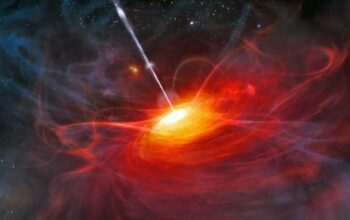
In the grand tapestry of astrophysics, supernovae serve as cosmic beacons illuminating the death throes of stars. These monumental explosions herald not only the end of stellar life but also the complex interplay of nuclear processes, dark energy, and perhaps even the enigmatic presence of dark matter. However, amidst the wealth of knowledge accrued over decades of rigorous research, a provocative and bold hypothesis posits that an unrecognized agent—darkness itself—might serve as a catalyst in supernova mechanics. As we navigate this intricate narrative, one cannot help but ponder: could it be that supernovae are, in some sense, ‘fueled’ by darkness?
To unpack this audacious proposition, one must first delineate our understanding of supernovae. The prevailing classification system identifies two primary types of supernovae: Type I and Type II. Type I supernovae occur in binary systems where a white dwarf accumulates matter from a companion star, culminating in a runaway nuclear fusion reaction. Conversely, Type II supernovae arise from the gravitational collapse of massive stars, leading to core implosion and subsequent explosion. Both scenarios hinge upon well-established physical principles, yet the idea that darkness—defined here not merely as the absence of light but as an obscuring, pervasive entity—could play a role offers an intriguing divergence from traditional protocols.
Darkness, in the cosmological context, often relates to dark matter and dark energy—two phenomena that conspire to obscure the structure and fate of the universe while simultaneously playing pivotal roles in its expansion. The hypothesis emerges from recent contemplations surrounding the cosmological balance. As the universe expands, its gravitational fabric stretches, and dark energy acts as a repulsive force, accelerating this expansion. But where does darkness fit into this celestial choreography? If one were to consider darkness as a metaphorical fuel, it may represent the unseen parameters influencing stellar environments before a supernova event occurs.
Imagine a scenario where the presence of dark matter—a form of matter that does not emit electromagnetic radiation—interacts with the baryonic matter (ordinary matter) in such a manner that it fosters conditions ideal for stellar collapse. In these hypothetical regions, gravitating dark matter could induce stress upon a star’s hydrostatic equilibrium, rendering it prone to violent collapse. Could such interactions, albeit subtle and difficult to detect, precipitate the conditions leading to supernovae? This line of inquiry challenges the assumption that supernovae originate solely from observable stellar processes, nudging one to explore the broader, invisible cosmic influences at play.
Furthermore, the suggestion that darkness could fuel supernovae might also invite consideration of the broader implications of dark energy. If dark energy serves as a cosmic fabric that sustains the universe’s expansion, might its fluctuations somehow interact with dying stars, augmenting the energy dynamics within their cores? Such a provocative juxtaposition introduces the playful question of whether supernova events could be incited by a depletion of dark energy in localized regions around massive stars. In other words, could a temporary absence or alteration of dark energy instigate a chain reaction, leading to the catastrophic release of a star’s energy as a supernova?
The consequences of this hypothesis resonate beyond the immediate physics of stellar explosions. If substantiated, the theory could potentially redefine our understanding of stellar evolution and cosmic evolution at large. It prompts us to reconsider our observational strategies. Are we observing supernovae in a vacuum, or could they be the telltale signs of dark matter interactions that have evaded our detection? Such revelations would not only advance theoretical frameworks but could also affect cosmological models that account for the universe’s ultimate trajectory.
Moreover, the implications of a strong correlation between darkness and supernovae could precipitate a resurgence in observational astronomy. A renewed focus on dark matter concentrations surrounding various types of stars might yield enlightening data regarding the mechanisms that govern stellar life cycles. Could specific supernovae serve as markers for local dark matter concentrations? Would this necessitate the development of new detection technologies focused on obscured cosmic phenomena? These questions unveil the manifold explorative avenues that could emerge from this hypothesis.
However, one must remain vigilant of the scientific method’s rigor. Any hypotheses must be tested against observational data and existing theoretical frameworks. To attribute the phenomenon of supernovae predominantly to darkness represents a departure from the established dogma; it requires extensive discourse, empirical validation, and critical evaluation. Such bold hypotheses are not uncommon in the annals of science but always demand robust scrutiny.
In summary, the hypothesis that supernovae might be fueled by darkness invites a reflective inquiry into the nature of cosmic phenomena. It amalgamates existing astrophysical principles with avant-garde thought, posing a compelling challenge to current scientific paradigms. This narrative underscores the necessity of questioning established norms and embracing the complexities of the universe’s makeup. As research continues to unfold, the cosmic dance of light and darkness endures, ever prompting us to ponder: what other mysteries lie beneath the shadows of our understanding?