

Short Answer
Definition of Dark Matter and Gravitational Lensing
Dark matter is a mysterious form of matter that does not emit, absorb, or reflect light, making it invisible to traditional astronomical observations. Despite its invisibility, it exerts a significant gravitational pull that influences the structure and evolution of the universe. One of the most compelling manifestations of dark matter’s presence is gravitational lensing, a phenomenon where the gravity of dark matter bends and distorts the path of light traveling through space.
- Dark Matter:
An unseen substance that constitutes a large portion of the universe’s mass, detectable only through its gravitational effects. - Gravitational Lensing:
The bending of light rays caused by the curvature of spacetime around massive objects, including dark matter.
Principles Behind Gravitational Lensing
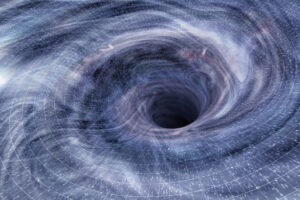
According to Einstein’s general theory of relativity, mass warps the fabric of spacetime, causing light to follow curved trajectories rather than straight lines. This curvature acts like a cosmic lens, bending light from distant sources such as galaxies or quasars as it passes near massive objects. Dark matter, although invisible, contributes significantly to this effect by creating gravitational wells that alter light’s path.
- Spacetime Curvature:
Mass-energy content distorts spacetime, guiding photons along curved geodesics. - Light Deflection:
Photons, despite having no mass, respond to gravity by bending around massive structures.
Types of Gravitational Lensing
Gravitational lensing manifests in several forms depending on the mass and scale of the lensing object:
- Strong Lensing:
Produces dramatic visual effects such as arcs, multiple images, and Einstein rings when light passes near very massive objects like galaxy clusters. - Weak Lensing:
Causes subtle distortions in the shapes of background galaxies, detectable only through statistical analysis of large samples. - Microlensing:
Results in temporary brightening of background stars when compact objects, possibly dark matter candidates, pass in front of them.
Mathematical Framework of Gravitational Lensing
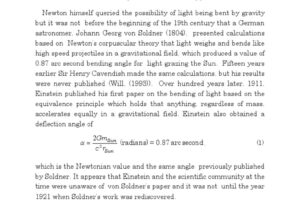
The bending angle of light due to gravitational lensing can be described by the lens equation derived from general relativity:
α = (4GM) / (c²b)
- α (alpha): Deflection angle of the light ray.
- G: Gravitational constant.
- M: Mass of the lensing object.
- c: Speed of light.
- b: Impact parameter, or the closest approach distance of the light to the mass.
This formula illustrates how the mass and proximity of the lensing object determine the degree to which light is bent.
Mapping Dark Matter Through Lensing
Gravitational lensing serves as a powerful observational tool to detect and map dark matter. Since dark matter does not interact with electromagnetic radiation, its distribution is inferred by analyzing the distortions it causes in the images of background celestial objects. These distortions act like fingerprints, revealing the density and arrangement of dark matter halos enveloping galaxies and clusters.
- Multiple Imaging:
Light from distant quasars or galaxies is split into several images by intervening dark matter concentrations. - Mass Distribution:
Patterns of lensing distortions help reconstruct the invisible mass landscape of the universe.
Cosmological Significance of Dark Matter Lensing
On the grandest scales, gravitational lensing by dark matter magnifies and reveals galaxies from the early universe, enabling astronomers to study cosmic history in unprecedented detail. Additionally, lensing effects imprinted on the cosmic microwave background radiation provide insights into the large-scale structure and evolution of the cosmos, including the behavior of dark energy and the validity of gravitational theories.
- Cosmic Magnification:
Enables observation of faint, distant galaxies otherwise beyond detection. - Mass Mapping:
Lensing tomography reconstructs the cosmic web of dark matter filaments connecting galaxies. - Testing Physics:
Provides empirical data to examine fundamental laws governing gravity and dark energy.
Philosophical and Scientific Implications
The phenomenon of light bending around dark matter challenges traditional notions of visibility and existence. It reveals a universe where unseen forces shape observable reality, emphasizing that invisibility does not equate to insignificance. This interplay between light and dark matter enriches both scientific understanding and philosophical reflection on the nature of reality and observation.
- Invisible Influence:
Dark matter’s gravitational effects make the unseen detectable through indirect means. - Reality and Perception:
Light’s distortion by dark matter invites reconsideration of what constitutes observable phenomena.
Common Misconceptions About Dark Matter and Gravitational Lensing
Dark matter emits light.
Dark matter does not emit, absorb, or reflect light; it is detected solely through gravitational effects.
Gravitational lensing only occurs with visible matter.
Lensing is caused by all mass, including invisible dark matter, which often dominates the effect.
Light always travels in straight lines.
Light follows curved paths in curved spacetime, bending around massive objects due to gravity.
Why Understanding Dark Matter’s Effect on Light Is Crucial
Studying how dark matter bends light is essential for unraveling the universe’s composition and evolution. It provides a unique window into the invisible scaffolding that shapes galaxies, clusters, and the cosmic web. This knowledge advances cosmology, informs theories of fundamental physics, and enhances our comprehension of the universe’s past, present, and future.
FAQ
What is dark matter?
Dark matter is a non-luminous material that makes up a significant portion of the universe's mass, inferred from its gravitational effects.
How does gravitational lensing work?
Gravitational lensing occurs when light from distant objects is bent by the gravitational field of massive objects, including dark matter.
Why is dark matter important in astronomy?
Understanding dark matter is crucial for revealing the universe's structure and evolution, as it influences galaxy formation and cosmic dynamics.


Leave a Reply