
Short Answer
Understanding Dark Matter and Its Role in the Universe
Dark matter is a mysterious and invisible form of matter that neither emits nor absorbs electromagnetic radiation, making it undetectable by conventional telescopes. Its existence is inferred primarily through its gravitational effects on visible matter, radiation, and the large-scale structure of the universe. Introduced in the early 20th century to explain discrepancies in galactic rotation speeds, dark matter has since become a fundamental element in cosmological models, believed to constitute the majority of a galaxy’s mass and to play a crucial role in the formation and stability of cosmic structures.
- Invisible yet influential:
Dark matter does not interact with light but exerts gravitational forces that affect the motion of stars and gas within galaxies. - Cosmic scaffolding:
It forms a vast, unseen framework known as the cosmic web, guiding the assembly and evolution of galaxies and galaxy clusters. - Standard cosmological component:
Dark matter is integral to the Lambda Cold Dark Matter (ΛCDM) model, the prevailing theory describing the universe’s composition and expansion.
Galaxies Without Dark Matter: A New Cosmic Puzzle
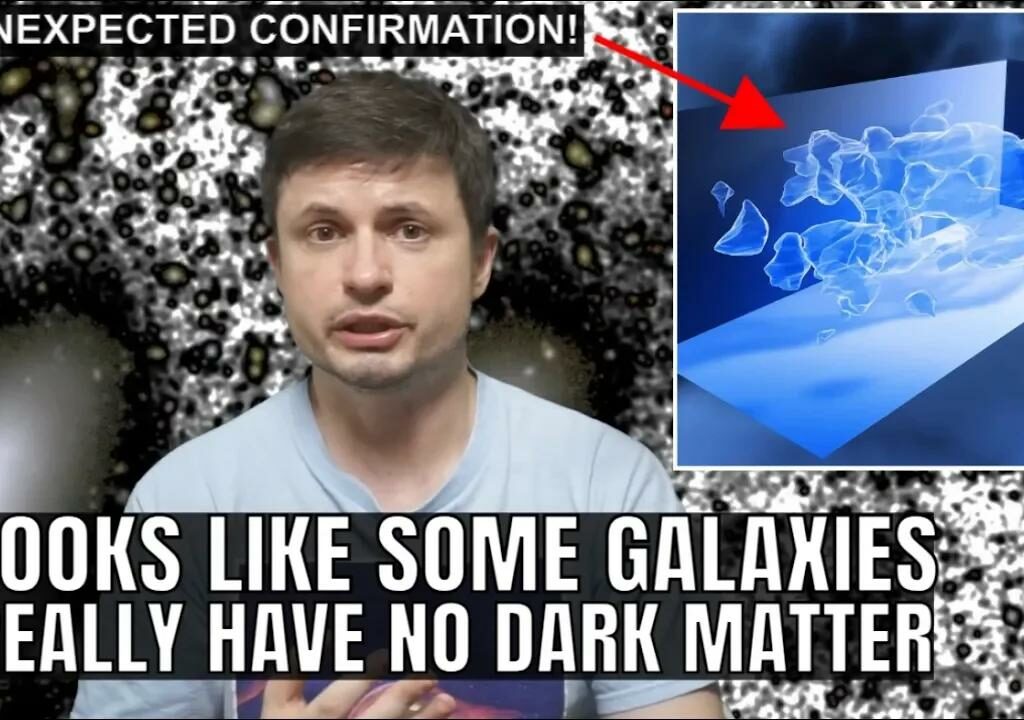
Recent astronomical discoveries have identified galaxies that appear to lack significant amounts of dark matter, challenging the long-standing assumption that dark matter is essential for galactic cohesion. These “dark matter-deficient” galaxies maintain their structural integrity and rotational dynamics primarily through their baryonic matter-stars, gas, and dust-without the gravitational support traditionally attributed to dark matter halos.
This phenomenon raises profound questions about galaxy formation and the fundamental forces at play. If galaxies can exist and remain stable without dark matter, it suggests alternative mechanisms or environmental factors might compensate for its absence, prompting a reevaluation of established cosmological theories.
Alternative Theories and Explanations
To account for galaxies lacking dark matter, scientists are exploring several hypotheses that either modify gravitational laws or consider environmental effects within the cosmic landscape.
- Modified Gravity Theories:
Approaches such as Modified Newtonian Dynamics (MOND) propose alterations to Newton’s laws at very low accelerations, potentially explaining galactic rotation curves without invoking dark matter. - Emergent Gravity:
This framework suggests gravity arises from quantum information principles, offering a different perspective on gravitational interactions that might account for observed galactic behaviors. - Environmental Effects:
Processes like tidal stripping or ram pressure in dense cosmic regions could remove dark matter halos from galaxies, leaving behind baryon-dominated systems that still hold together due to their own mass.
Implications for Dark Matter Detection and Cosmology
The existence of galaxies without detectable dark matter challenges current methods of inferring dark matter presence, which rely heavily on gravitational effects. It highlights the necessity for more sensitive instruments and refined observational techniques to distinguish truly dark matter-free galaxies from those with faint or diffuse halos. Additionally, it suggests that dark matter particles, if they exist, might have more complex properties or distributions than previously thought.
On a broader scale, these findings compel scientists to reconsider the universality of dark matter in cosmic models. Since dark matter underpins explanations for phenomena ranging from the cosmic microwave background to galaxy cluster dynamics, exceptions to its presence invite a reexamination of foundational assumptions and encourage openness to new theoretical frameworks.
Scientific and Philosophical Significance
The discovery of dark matter-deficient galaxies exemplifies the evolving nature of scientific inquiry, where anomalies drive progress by challenging established paradigms. It underscores the importance of maintaining a flexible and inquisitive approach to understanding the universe, recognizing that current models may be incomplete or require modification in light of new evidence.
Moreover, this anomaly opens avenues for potential breakthroughs in physics, including the possibility of uncovering new particles, forces, or modifications to existing theories. It fosters interdisciplinary collaboration between astronomers, physicists, and cosmologists to unravel the complexities of galactic formation and the fundamental laws governing the cosmos.
Future Directions in Research
The study of galaxies lacking dark matter is still emerging, with ongoing and future observations poised to shed light on their prevalence, origins, and characteristics. Advanced telescopes and sophisticated simulations will play a critical role in determining whether these galaxies are rare exceptions or representatives of a broader, previously unrecognized class.
Such research promises to enrich our cosmic inventory and deepen our appreciation of the universe’s diversity, complexity, and the myriad processes shaping its evolution.
Conclusion: Embracing Cosmic Complexity
The revelation that some galaxies may exist without dark matter invites a transformative shift from a singular, dark matter-centric view of galactic formation to a more nuanced and pluralistic understanding. This shift highlights the dynamic and self-correcting nature of science, where each new discovery prompts reassessment and refinement of knowledge.
As humanity’s observational capabilities expand and theoretical models evolve, the universe continues to reveal unexpected phenomena that challenge our perceptions and inspire deeper exploration. The enigma of dark matter-free galaxies stands as a testament to the enduring spirit of scientific curiosity and the ongoing quest to comprehend the cosmos in all its complexity.
FAQ
What is dark matter?
Dark matter is a form of matter that does not emit or absorb light, making it invisible and detectable only through its gravitational effects.
How do galaxies without dark matter remain stable?
They rely on baryonic matter, such as stars and gas, to maintain their structural integrity.
What implications do these findings have for dark matter research?
They suggest a need for new observational techniques and a reconsideration of existing cosmological models.


Leave a Reply