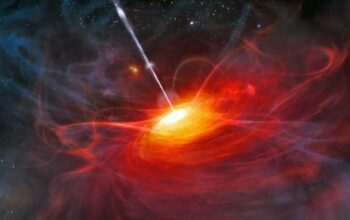
In the vast expanse of the cosmos, black holes are often depicted as the unfathomable voids, the dark lords of the universe that devour everything in their proximity. However, recent astronomical advancements have unveiled a fascinating dimension to these enigmatic entities, particularly through the phenomenon of gravitational lensing. This intriguing astrophysical effect offers a unique lens—both literally and metaphorically—by which we can scrutinize black holes more closely than ever before.
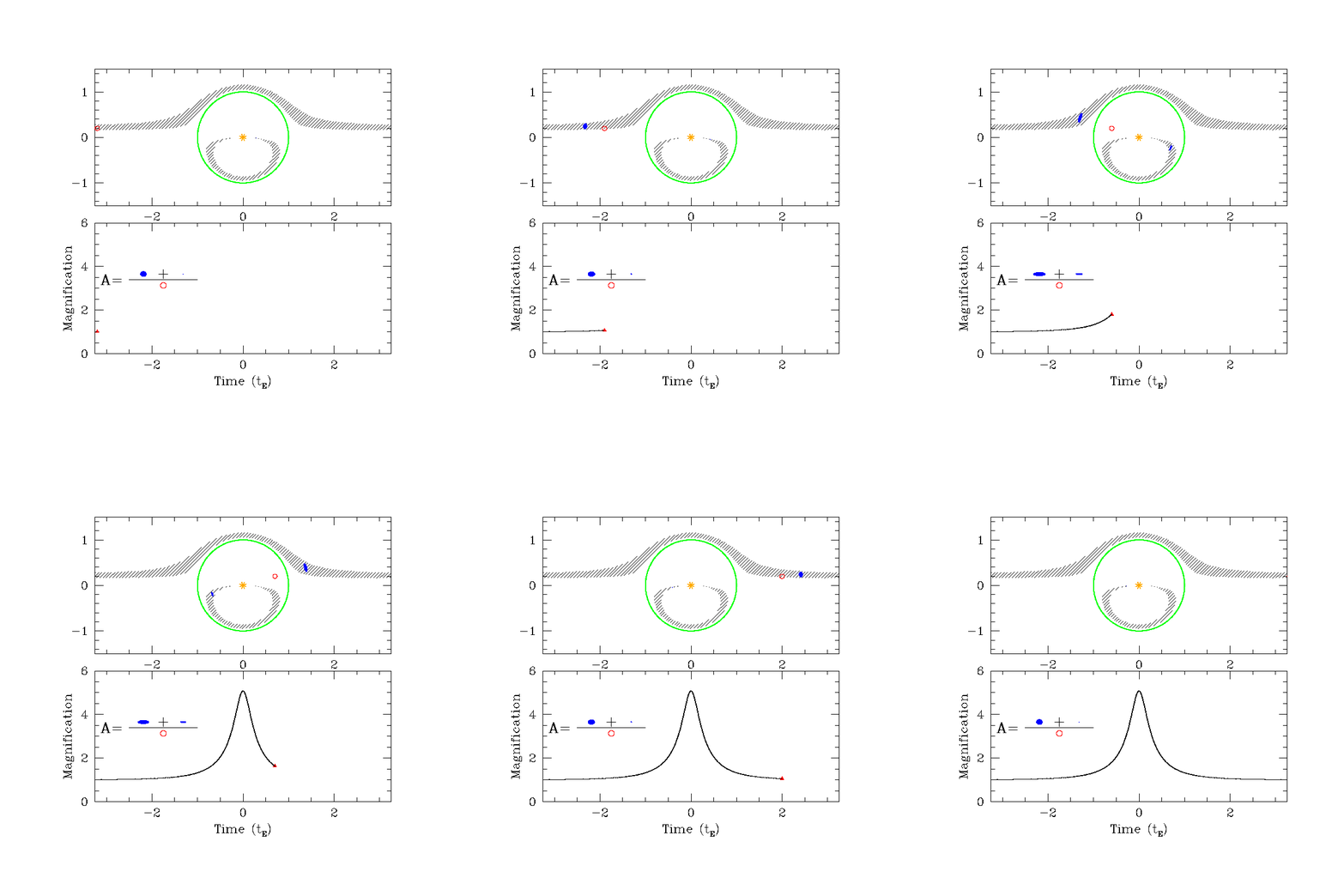
Gravitational lensing occurs when a massive object, such as a galaxy, distorts the fabric of space-time due to its strong gravitational field. Imagine dropping a large stone into a tranquil pond; the ripples created in the water serve as a representation of how massive celestial bodies affect the trajectory of light. When light from distant stars or galaxies passes near these massive objects, its path is altered, allowing us to observe multiple images or a magnified version of the background celestial objects. Consequently, galactic lenses not only illuminate the nature of the background universe, but they also provide a closer scrutiny of the black holes that may reside within these galactic structures.
Recent investigations have showcased that these gravitational lenses can shrink the perceived dimensions of black holes, challenging our traditional understanding of their enormity and influence. The act of observing a black hole, once considered an insurmountable endeavor due to their inherent obscurity, has become a tantalizing adventure. As light bends around the galaxy acting as a lens, the attributes of the black hole become discernible; mass, spin, and even the surrounding accretion disks are rendered visible. The ability to gauge these characteristics through gravitational lensing affords astronomers a more nuanced comprehension of black holes.
To delve deeper into this subject, one must explore the intricacies of light and gravity. According to Einstein’s theory of general relativity, gravity is not merely a force but an intrinsic property of space-time itself, dictating how light behaves in its presence. As light traverses the curvatures of space-time molded by massive objects, it becomes a pathway to enlightenment. Through this lens, one can perceive the staggering intensity of black holes, which, while ostensibly omnipotent, can appear deceptively small and thus approachable.
Consider the analogy of a magician pulling a rabbit from an empty hat. The black hole, akin to the elusive rabbit, seems to vanish from sight, obscured by the cosmic cloak of space-time. Yet, through the intricate fabric of gravitational lensing, one unveils the black hole’s true nature—a compelling interplay between visibility and obscurity. Such a perspective repositions black holes not only as destructive forces but also as integral players within the cosmic ballet of formation and evolution.
Furthermore, the implications of understanding black holes through gravitational lensing extend beyond mere curiosity. As astronomers build more advanced observational facilities that leverage this phenomenon, the quest to solve the cosmic enigma of dark matter and dark energy intensifies. These elusive components of the universe might interact with black holes in ways previously unimagined. If galactic lenses can reveal insights into black holes, might they also unveil the mysteries hidden in the shadowy realms of dark matter? Each revelation surrounding gravitational lensing strengthens the interconnected web of cosmic knowledge we have thus far gleaned.
What makes this topic even more compelling is the paradoxical notion of black holes acting as windows into the universe’s past. Their formation is tightly interwoven with the fate of galaxies. As one observes how gravitational lenses operate, one begins to realize that these dark cores can also narrate the stories of their host galaxies—the violent collisions and mergers that give birth to hybrid structures, reflective of all the turbulence and evolutionary trajectories that characterize galactic dynamics.
The universe, while overwhelmingly vast, reveals its wonders through such cosmic spectacles. The interplay between light, gravity, and the complexities of black holes presents a marvel of nature, a multi-dimensional tapestry where each thread pulls at the fabric of existence itself. This continuous dance beckons mankind to engage in deeper cosmic contemplation, urging us to reflect on our place within the universe’s grand design.
In conclusion, the phenomenon of gravitational lensing demonstrates that black holes, rather than being mere abysmal voids—a simplistic view engendered by their formidable reputation—can be understood through multidimensional narratives that showcase their role and impact on the cosmos. The intricate relationship between galactic lenses and black holes not only enhances our understanding of these esoteric entities but also provokes deeper inquiries into the very nature of reality itself. As scientists continue to unlock the secrets of our universe, we are compelled to look through the lenses of their research, unveiling the intricate patterns woven into the celestial dance that lies beyond the event horizons.