Electron transfer is a fundamental process underlying many phenomena in physics, chemistry, and biology. Traditionally understood through the lens of classical mechanics, recent advancements usher in a paradigm shift by illuminating electron transfer through the fascinating and perplexing framework of quantum mechanics. Specifically, the concept of quantum tunneling emerges as a pivotal mechanism in this domain. This exploration aims to simplify the intricacies of electron transfer while simultaneously evoking a sense of curiosity and wonder about its ramifications.
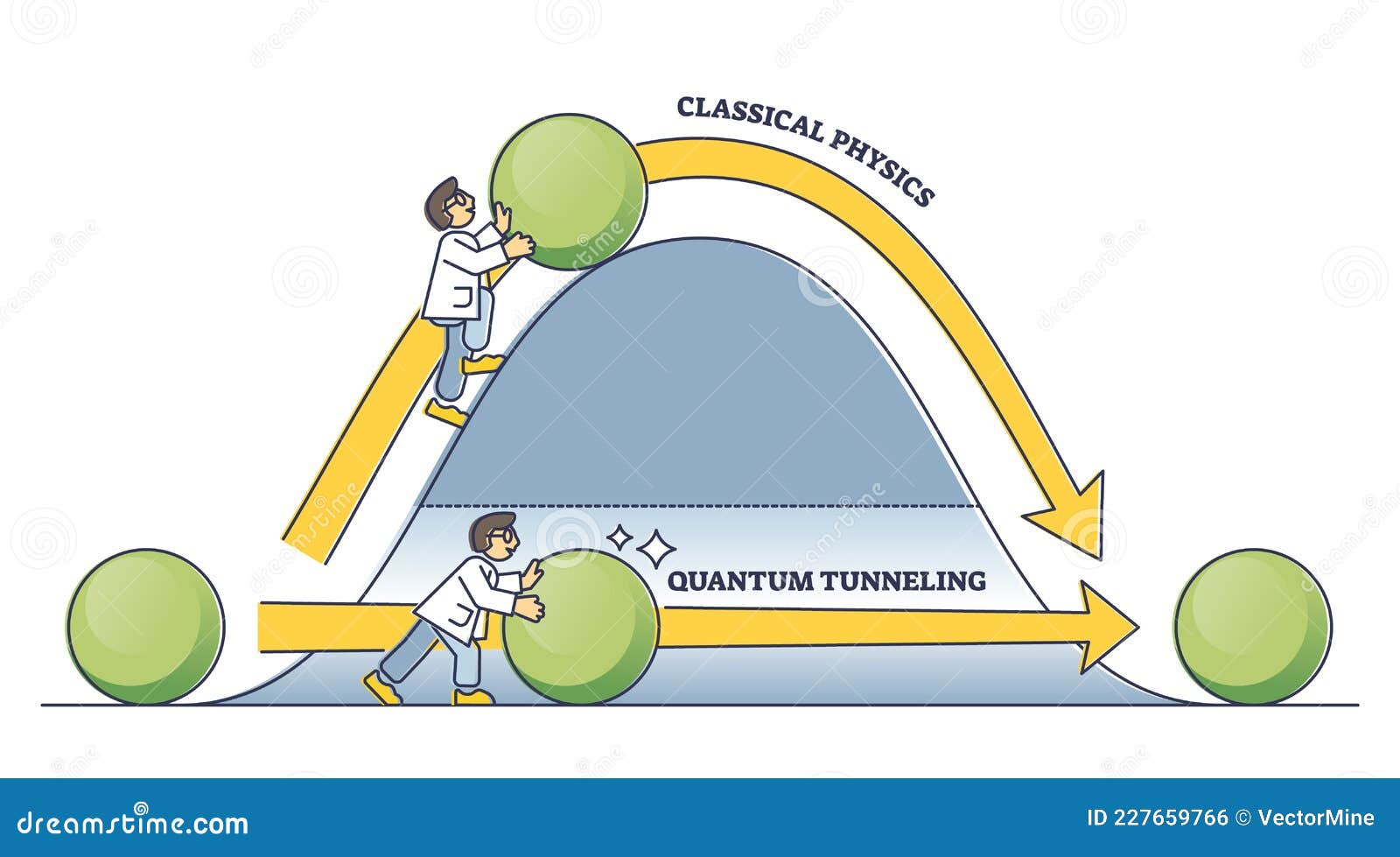
At the heart of the matter lies the assumption that particles, such as electrons, behave according to classical Newtonian mechanics. This perspective holds that an electron requires sufficient energy to surpass a potential barrier, akin to a ball rolling over a hill. However, as one delves deeper into the quantum realm, it becomes apparent that this classical analogy fails to provide a comprehensive understanding. Quantum mechanics, with its unique principles, allows for electron behavior that challenges our conventional perceptions.
Quantum tunneling posits that an electron can traverse a potential barrier even when it lacks the requisite classical energy to do so. This occurs because, within the quantum framework, particles do not possess fixed positions and momenta. Instead, they are described by a wave function, representing a probability distribution. Consequently, there exists a nonzero probability that an electron can be found on the other side of an energy barrier, even if the barrier exceeds the electron’s energy.
The implications of quantum tunneling extend beyond mere theoretical curiosity; they manifest tangible consequences in a plethora of scientific fields. For instance, in biochemistry, quantum tunneling facilitates electron transfer reactions in enzymatic processes, wherein enzyme-catalyzed reactions entail the movement of electrons between atoms. The phenomenon helps elucidate the efficacy of enzymes, which often catalyze reactions that would otherwise be energetically prohibitive. By allowing electrons to tunnel through energy barriers, enzymes effectively expedite biochemical reactions, enhancing the overall rate at which biological processes occur.
Furthermore, quantum tunneling plays a crucial role in photosynthesis, an essential mechanism for life on Earth. During photosynthetic processes, energy is harvested from sunlight and converted into chemical energy. One contributing path within this intricate process involves the transfer of electrons through a series of protein complexes in plant cells. Here, the electron tunneling mechanism not only aids in the efficient transfer of energy but also underscores the remarkable interplay between quantum mechanics and biological systems.
In addition to its biological implications, the quantum tunneling paradigm is instrumental in understanding various technologies. For instance, the operation of tunnel diodes exploits quantum tunneling principles. Tunnel diodes, characterized by their negative resistance, utilize the ability of electrons to tunnel through potential barriers to create high-speed electronic components. As the world pivots towards semiconductor technology, the understanding of quantum tunneling becomes increasingly vital. Innovations in electronics hinge upon mastering quantum principles to develop faster and more efficient devices.
As we navigate the future, the potential applications of quantum tunneling extend into the realm of quantum computing. Unlike classical computers, which rely on bits that exist in a binary state, quantum computers utilize qubits that can exist in a superposition of states. The ability of electrons to tunnel between states facilitates rapid computational processes, offering the promise of unparalleled processing power. As quantum computing continues to evolve, the exploration of electron tunneling becomes pivotal in harnessing the full potential of this nascent technology.
Cognizance of quantum tunneling also invites introspection into the philosophical dimensions of scientific inquiry. The very nature of reality as conceptualized by quantum mechanics prompts fundamental questions regarding determinism, locality, and the essence of observation. If particles can traverse barriers that they classically should not, what does this imply for our understanding of causality? Engaging with these profound inquiries not only expands intellectual horizons but also enhances our appreciation for the mysteries that underpin the universe.
To further elucidate the concept of quantum tunneling, it is constructive to examine the mathematical equations underpinning the phenomenon. The Schrödinger equation serves as the cornerstone of quantum mechanics and, consequently, tunneling. This wave function equation encapsulates the probabilistic nature of electrons, offering a mathematical framework to predict tunneling likelihoods. Through the manipulation of the Schrödinger equation and the calculation of transmission coefficients, researchers can quantitatively assess the probability of an electron tunneling through a barrier of varying height and width.
The complexity of quantum tunneling is underscored by variances in barrier thickness and electron energy, influencing tunneling probabilities. Such quantifiable parameters not only assist in theoretical applications but also pave the way for experimental verification. Contemporary experiments employing advanced techniques, such as scanning tunneling microscopy, have provided visual manifestations of tunneling activity, offering a fascinating glimpse into this enigmatic process.
In summary, the exploration of electron transfer through quantum tunneling reveals intriguing dimensions of the quantum world. By transcending classical constraints, quantum tunneling elucidates fundamental processes within chemistry, biology, and technology. This nuanced understanding invites researchers and inquisitive minds alike to ponder the broader implications of quantum mechanics on our comprehension of the universe. As exploration in this field progresses, quantum tunneling promises to remain a cornerstone of inquiry, continuing to bridge the realms of the micro and macrocosm, ultimately shaping the future trajectory of scientific discovery.