
Short Answer
Definition of the Universe’s Ultimate Fate
The ultimate destiny of the universe is a profound question that has fascinated scientists, philosophers, and inquisitive minds for generations. It concerns whether the cosmos will continue expanding endlessly or eventually reverse its course and collapse. This inquiry hinges on the complex interactions of cosmic forces, the enigmatic nature of dark energy, and the fundamental geometry of space-time. Understanding these elements provides insight into various theoretical outcomes and their implications for the future of all existence.
Historical Context and Cosmic Expansion
The foundation for comprehending the universe’s fate lies in the concept of cosmic expansion. Since Edwin Hubble’s pivotal discovery in the 1920s that galaxies are moving away from each other, it has been clear that the universe is not static but expanding. This dynamic nature of the cosmos introduced a new paradigm, shifting away from the idea of an eternal, unchanging universe. The mechanisms driving this expansion are deeply rooted in Einstein’s theory of general relativity, as well as the influences of dark matter and dark energy.
Key Cosmological Parameters: The Density Parameter (Ω)
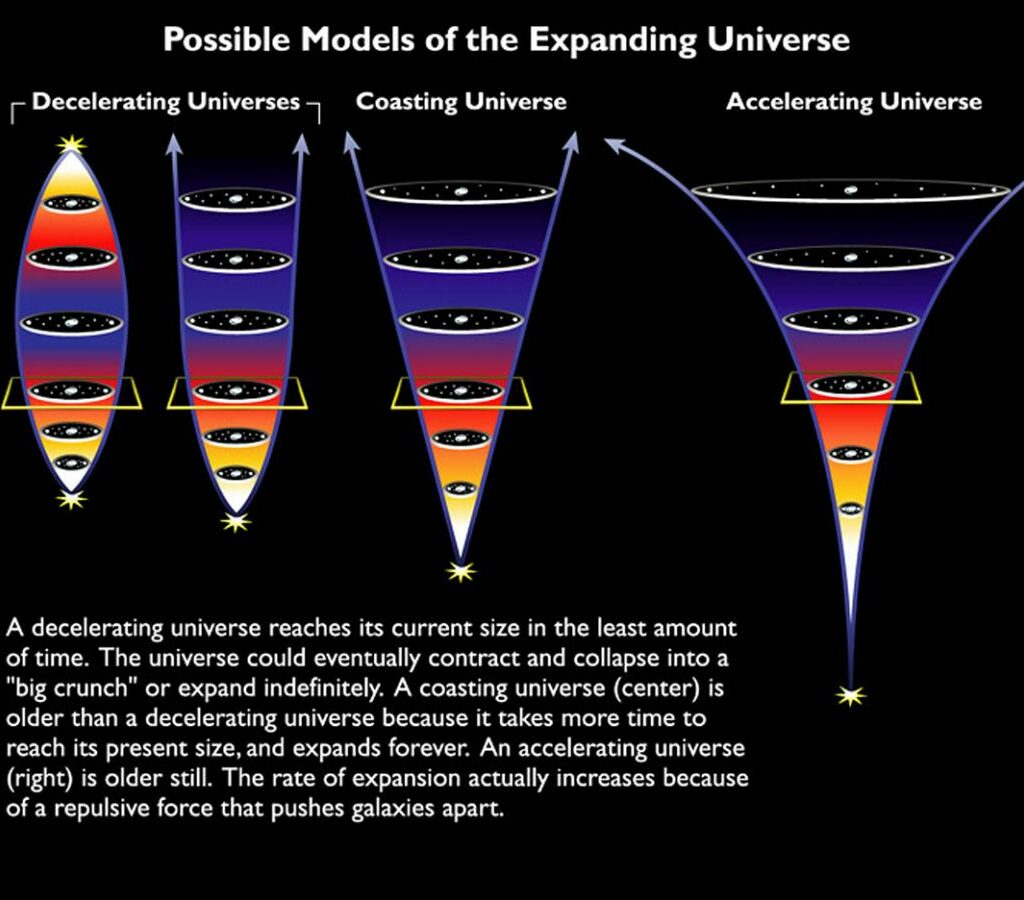
A critical factor in predicting the universe’s future is the density parameter, denoted as Omega (Ω). This parameter measures the ratio between the actual density of matter and energy in the universe and the critical density required for a balanced cosmic state. The value of Ω determines the universe’s trajectory:
- Ω > 1:
The universe’s gravity is strong enough to eventually stop expansion and trigger a contraction, leading to a “Big Crunch.” - Ω < 1:
The universe will expand forever, with matter and energy becoming increasingly sparse, culminating in a cold, empty cosmos. - Ω = 1:
Represents a flat universe that expands indefinitely but at a gradually slowing pace.
The Big Crunch: A Collapsing Universe
The Big Crunch hypothesis envisions a scenario where gravitational attraction ultimately overcomes expansion. In this model, the universe’s growth decelerates, halts, and reverses, causing galaxies to converge and cosmic structures to compress. This process would dramatically increase temperatures and densities, culminating in a state of extreme compactness. Some oscillatory cosmologies propose that such a collapse could be followed by another Big Bang, suggesting a cyclical pattern of cosmic death and rebirth. However, recent empirical data challenge the likelihood of this outcome.
Dark Energy and Accelerating Expansion
The discovery of dark energy in the late 1990s transformed our understanding of cosmic evolution. Dark energy is a mysterious force permeating space, responsible for accelerating the universe’s expansion. Unlike matter, which exerts gravitational attraction, dark energy produces a repulsive effect, pushing galaxies apart at increasing speeds. This phenomenon was revealed through observations of distant Type Ia supernovae, which showed that the universe’s expansion is not slowing but speeding up.
Composition and Nature of Dark Energy
Dark energy constitutes roughly 70% of the universe’s total energy content, overshadowing the combined mass of ordinary matter and dark matter. Despite its dominance, the true nature of dark energy remains elusive. Two main hypotheses exist:
- Cosmological Constant:
Dark energy as a constant vacuum energy intrinsic to space itself. - Dynamic Field:
Dark energy as a time-evolving field, potentially changing its properties over cosmic timescales.
The distinction between these models significantly influences predictions about the universe’s long-term behavior.
Possible End Scenarios Driven by Dark Energy
Depending on the characteristics of dark energy, several ultimate fates are conceivable:
- Big Freeze (Heat Death):
If dark energy remains constant, the universe will expand forever at an accelerating rate. Galaxies beyond local clusters will recede beyond observable limits, star formation will cease, and existing stars will burn out, leaving a cold, dark, and dilute cosmos approaching thermodynamic equilibrium. - Big Rip:
Should dark energy’s repulsive force increase without limit, it could eventually overpower all forces binding matter. This would lead to the disintegration of galaxies, stars, planets, atoms, and even subatomic particles, tearing space-time apart in a finite time.
Alternative Theories and Modifications to Gravity
Beyond the standard dark energy models, some theories propose modifications to gravity on cosmological scales. Concepts such as quintessence or extra spatial dimensions suggest that the interaction between gravity and dark energy might vary, potentially altering the universe’s fate. These frameworks allow for scenarios where acceleration could slow, reverse, or lead to novel cosmic endpoints beyond the traditional expansion-collapse dichotomy.
Observational Evidence and Current Understanding
Extensive observational data underpin current cosmological models. Measurements of the cosmic microwave background radiation, galaxy cluster distributions, baryon acoustic oscillations, and gravitational lensing collectively support a spatially flat universe dominated by dark energy and dark matter. These findings favor a future of perpetual expansion rather than collapse. Nonetheless, the precise properties of dark energy and its potential evolution remain subjects of active investigation.
Philosophical and Scientific Significance
Exploring the universe’s ultimate fate extends beyond astrophysics, touching on philosophical questions about existence, time, and reality. An eternally expanding universe suggests a gradual cosmic desolation but also the possibility of emergent phenomena within gravitationally bound systems. Conversely, a collapsing universe implies a cosmic cycle of death and rebirth, embodying dynamic transformation on a universal scale.
Conclusion: The Open Cosmic Narrative
In summary, the destiny of the universe is a complex interplay of advanced physics and profound existential inquiry. Present evidence points toward an accelerating expansion driven by dark energy, leading to a cold, distant future. However, the enigmatic nature of dark energy leaves room for alternative outcomes. Continued observational advancements and theoretical developments are essential to unraveling this cosmic mystery. Until then, the story of the universe’s fate remains an unfolding epic, inscribed across the fabric of space-time in awe-inspiring ways.
FAQ
What is the ultimate fate of the universe?
The ultimate fate of the universe can either be endless expansion or eventual collapse, influenced by cosmic forces and dark energy.
What is dark energy?
Dark energy is a mysterious force that drives the accelerated expansion of the universe, constituting about 70% of its total energy content.
What is the Big Crunch?
The Big Crunch is a theoretical scenario where gravitational forces eventually halt the universe’s expansion and lead to a collapse.
What are the possible scenarios for the universe's end?
Possible scenarios include the Big Freeze, where the universe continues to expand and cool, or the Big Rip, where dark energy tears apart all structures.
Leave a Reply