
Short Answer
Definition of Black Holes
Black holes are extraordinary regions in spacetime characterized by gravitational forces so powerful that nothing, including light, can escape their grasp. These cosmic entities have intrigued scientists and the general public for decades due to their mysterious nature and extreme physical properties.
- Event Horizon:
The defining boundary of a black hole beyond which no information, matter, or energy can return to the outside universe. - Gravitational Pull:
The immense force exerted by black holes that warps spacetime and traps everything within their vicinity.
Fundamental Characteristics and Structure
At the heart of a black hole lies the event horizon, a critical threshold marking the point of no return. Once matter or radiation crosses this boundary, it becomes inaccessible to external observers. Traditionally, black holes were viewed as eternal consumers of matter, swallowing everything without releasing anything back into space. However, modern research reveals a more intricate picture, where black holes engage in complex interactions that blur the lines between destruction and creation.
Quantum Effects and Hawking Radiation
In the 1970s, physicist Stephen Hawking introduced a groundbreaking concept known as Hawking radiation. This phenomenon arises from quantum effects near the event horizon, allowing black holes to emit particles and gradually lose mass over time. Although this radiation is extremely weak and difficult to detect in large black holes, it challenges the classical view of black holes as completely dark and inescapable.
- Particle Emission:
Quantum fluctuations near the event horizon produce particle-antiparticle pairs, with one escaping as radiation. - Mass Loss:
The emission of Hawking radiation causes black holes to slowly evaporate, potentially leading to their eventual disappearance.
Accretion Disks and Energy Emission
Matter spiraling into a black hole forms an accretion disk, where intense gravitational and frictional forces heat the material to extreme temperatures. This process releases vast amounts of energy, primarily in the form of X-rays and gamma rays. These energetic emissions can influence the surrounding environment by triggering the formation of new elements and even stars, positioning black holes as indirect agents of cosmic creation.
Relativistic Jets and Matter Redistribution
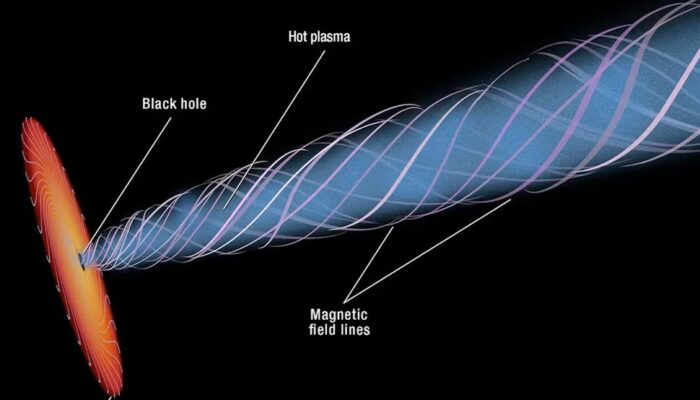
Some black holes, particularly those at galactic centers, generate powerful jets composed of relativistic particles that shoot out across intergalactic distances. These jets originate from complex interactions within the accretion disk and magnetic fields near the black hole. By expelling matter and radiation outward, these jets enrich the interstellar medium with essential elements, fostering the development of planetary systems and potentially life.
Primordial Black Holes and Cosmic Structure Formation
Speculative theories propose that primordial black holes formed shortly after the Big Bang due to density fluctuations in the early universe. These ancient black holes may have influenced the gravitational landscape, playing a role in shaping the large-scale structure of the cosmos by affecting how matter clumped together to form galaxies and clusters.
The Information Paradox and Matter Preservation
A profound question in black hole physics is whether matter truly disappears once it crosses the event horizon. The “information paradox” challenges the idea that information about infalling matter is lost forever. Advances in quantum gravity and string theory suggest that information is preserved in a transformed state, encoded on the event horizon itself, according to the holographic principle. This concept implies that black holes do not annihilate matter completely but rather convert and store its information in a novel form.
Gravitational Waves and Black Hole Mergers
The emerging field of gravitational wave astronomy provides new insights into black hole behavior. When two black holes collide, they emit ripples in spacetime that carry detailed information about their properties and the dynamics of their merger. These events not only consume matter but also create larger black holes, redistributing mass and energy throughout the universe and illustrating the continuous cycle of cosmic evolution.
Why Black Holes Are Both Destroyers and Creators
Black holes embody a paradoxical duality: they are simultaneously agents of destruction and catalysts for creation. While they consume matter locally, processes such as Hawking radiation, energetic emissions from accretion disks, and relativistic jets contribute to the generation and redistribution of matter and energy elsewhere. This dynamic interplay highlights the universe’s complex system of transformation, where matter and energy perpetually cycle through phases of annihilation and renewal.
Conclusion: The Cosmic Significance of Black Holes
Black holes occupy a unique position at the intersection of classical physics and quantum mechanics, challenging our understanding of matter’s ultimate fate. Although they appear to obliterate matter by drawing it beyond the event horizon, quantum phenomena and astrophysical processes reveal that matter is not lost forever. Instead, it participates in an ongoing cosmic exchange, encoded, radiated, or reformed in various ways. Black holes thus symbolize the delicate balance between entropy and order, destruction and creation, urging us to reconsider the fundamental nature of reality and the destiny of matter in the universe.
FAQ
What is a black hole?
A black hole is a region in spacetime where gravity is so strong that nothing, including light, can escape.
Do black holes create or destroy matter?
Black holes can destroy matter by consuming it, but they can also create matter through processes like Hawking radiation and energetic emissions.

Leave a Reply