In the ever-evolving panorama of modern physics, the interplay of light and its enigmatic properties comes to the forefront, particularly in the realm of twisted light and entangled photons. This discourse investigates the profound implications of these phenomena, particularly concerning the conventional understanding of causality. At the intersection of quantum mechanics and optics, twisted light emerges as a kaleidoscopic manifestation of the intricate workings of the universe.
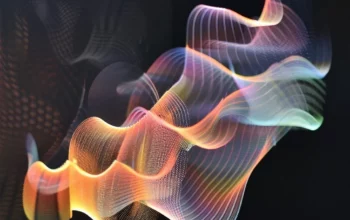
Twisted light, often referred to in the context of orbital angular momentum (OAM), displays unique characteristics that set it apart from conventional beams. Unlike standard light waves that propagate in uniform patterns, beams of light exhibiting OAM possess a helical phase front. This geometric shift allows such beams to carry angular momentum, akin to how a corkscrew incorporates a twist. As we delve deeper into this captivating subject, the implications of twisted light reach far beyond mere scientific curiosity; they hold the prospect of revolutionizing communication technologies, quantum computing, and fundamental physics itself.
At the core of the conversation surrounding twisted light is the concept of entanglement—a quintessential feature of quantum mechanics. When two photons become entangled, they share a state such that the measurement of one instantaneously influences the state of the other, regardless of the distance separating them. This enigmatic relationship challenges traditional notions of locality and separability, raising profound questions about causality. Under this quantum lens, the familiar boundaries of cause and effect dissolve into an intricate tapestry of probabilities, defying classical interpretations.
Consider the metaphor of a cosmic dance. In this ballet of subatomic particles, entangled photons are like dance partners—each movement synchronously affecting the other, yet separated by vast expanses of space. This synchronicity invites contemplation of a non-local universe, where conventional rules of engagement no longer apply. Causality, as understood by classical physics, is redefined; actions taken in one locale reverberate instantaneously in another, prompting a reevaluation of the deterministic narrative that has long dominated scientific discourse.
The allure of twisted light lies not solely in its peculiar physical attributes but also in its potential applications. In telecommunications, for instance, twisted light beams can encode vast amounts of information. By utilizing their unique properties, such systems can enhance bandwidth and security simultaneously. This opens the door to more efficient data transmission, which is critical in the age of information overload. The leverage provided by quantum entanglement in securing communication channels further emphasizes the practical ramifications of twisted light.
Moreover, the quantum state of twisted light and entangled photons serves as a remarkable resource for quantum computing. The superposition of various states inherent to entangled particles can be harnessed to execute calculations at speeds unattainable by classical computers. This potentially marks a paradigm shift in computational capabilities, providing solutions to complex problems that remain intractable within the confines of classical frameworks.
The implications of entangled photons reach into the heart of fundamental physics as well. As researchers seek to understand the nature of spacetime and the universe’s fundamental fabric, twisted light provides a valuable avenue for exploration. A multitude of experimental setups, including those utilizing photons to test Bell’s theorem, have demonstrated the non-local correlations inherent to entanglement. Such experiments not only bolster the validity of quantum mechanics but also create a richer tapestry for understanding the universe.
As we navigate this intricate landscape, the philosophical dimensions of entwined photons and causality become increasingly pronounced. The ramifications challenge our epistemological constructs, compelling scientists and philosophers alike to grapple with the nature of reality. What does it mean for cause and effect when quantum entanglement supersedes geographical and temporal constraints? Such deliberations evoke a paradigm that invites skepticism of simplistic interpretations rooted in Newtonian physics. Entangled photons symbolize a gateway to a more nuanced understanding of existence, one that embraces paradoxes and uncertainties as fundamental properties of reality.
Moreover, twisted light serves to bridge disciplines, uniting physicists with artists, philosophers, and technologists. The art-inspired concept of twisting resonates through the discourse, signifying that beauty exists in the complexity of the natural world. This convergence embodies the pursuit of knowledge that transcends isolated fields, forging connections that illuminate the interconnectedness of all phenomena.
In conclusion, the exploration of twisted light and entangled photons not only redefines causality but also beckons inquiry into our broader understanding of the cosmos. Through this narrative, we observe a continuum where empirical science and abstract thought converge, inspiring innovation and philosophical contemplation alike. The radiant dance of twisted light, emblematic of entanglement, serves as a profound reminder of the complexities that lie beneath the surface of reality. As the entrenched paradigms of causality continue to evolve under quantum scrutiny, the journey of discovery promises to illuminate pathways toward a deeper comprehension of the universe’s enigmatic nature.