Can we bottle the cosmos? This seemingly whimsical question invites a deeper exploration into the enigmatic realm of dark energy. The universe, in its vast magnificence, is primarily composed of dark energy, an elusive force responsible for the accelerated expansion of the cosmos. Understanding dark energy poses one of the most formidable challenges in contemporary astrophysics. This article delves into various experimental approaches to studying dark energy in laboratory settings, contemplating the theoretical and practical implications of isolating and harnessing this cosmic phenomenon.
The cosmos is governed by fundamental forces that dictate the behavior of matter and energy on both macroscopic and microscopic scales. Since the 1990s, astronomers have observed that galaxies are receding from us at an accelerated rate, a discovery that led to the postulation of dark energy as a driving force behind this expansion. Approximately 68% of the universe is theorized to consist of dark energy, yet its nature remains largely speculative. This pervasive presence adds layers of complexity to our understanding of the universe while presenting a tantalizing challenge for scientists: how can we study something so omnipresent yet elusive?
To embark on this journey, one must first grapple with the fundamental characteristics of dark energy. Predominantly associated with the cosmological constant—a term introduced by Albert Einstein in his equations of general relativity—dark energy is believed to have a uniform density throughout space. Its exact properties are still a subject of extensive debate. Various models exist, including quintessence, which suggests that dark energy could vary across space and time, and modified gravity theories, which propose alterations to established gravitational principles. Understanding these models is crucial for envisioning experimental designs aimed at probing dark energy in controlled environments.
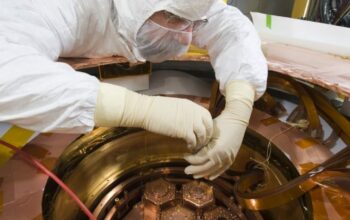
A laboratory investigation of dark energy faces intrinsic difficulties. One central question is how to simulate an expansive universe within the confines of a laboratory. Current experimental approaches have utilized high-energy particle colliders and precision measuring devices to capture elusive interactions that may yield insights into dark energy’s properties. For instance, large-scale cosmic surveys are conducted to analyze the distribution of galaxies, linking observations with theoretical models to infer the characteristics of dark energy. However, these studies primarily rely on external cosmic phenomena rather than direct laboratory manipulation.
In contrast, innovative methodologies are being designed to simulate conditions analogous to those in the universe. For example, researchers are employing ultracold atoms to explore the effects of dark energy in a controllable setting. This has led to the development of quantum systems capable of mimicking aspects of cosmic behavior. By manipulating atomic interactions and harnessing quantum entanglement, scientists can create effective models that reflect dark energy’s influence on spacetime. Such experiments yield invaluable data, enhancing theoretical understanding and potentially leading to new frameworks to elucidate this cosmic puzzle.
Additionally, the advent of advanced technologies such as laser interferometry, coupled with high-precision measurements, allows researchers to probe gravitational waves—ripples in spacetime that may provide indirect evidence of dark energy. Analyzing the signals from gravitational wave events could reveal the interplay between dark energy and other fundamental forces. This avenue of investigation not only broadens the scope of potential dark energy research but also exemplifies the interdisciplinary nature of contemporary physics, merging cosmology with quantum mechanics.
However, to truly “bottle” dark energy would require breakthroughs in understanding its core principles. A multidisciplinary approach is vital in addressing the intricacies of dark energy theory. Physicists, cosmologists, and mathematicians must collaborate to refine existing models and explore novel theoretical frameworks. This collaborative effort may yield new insights into the potential for laboratory-based dark energy research, identifying methods to manipulate dark energy or its effects under controlled circumstances.
The philosophical implications of isolating dark energy warrant consideration as well. If researchers were to develop a methodology for capturing dark energy, it could prompt profound questions regarding the nature of the universe and existence itself. What would it mean to have direct access to a fundamental component of the cosmos? Such advancements could lead to revolutionary technologies, enabling us to influence spacetime in unprecedented ways. Yet, this also raises ethical dilemmas regarding the manipulation of universal forces that, as of now, operate beyond human control.
Moreover, the question of whether we could ‘bottle’ dark energy transcends mere curiosity; it presses the boundaries of scientific inquiry and innovation. It serves as a reminder of the limitations that persist in our understanding of the cosmos, while simultaneously igniting a collective ambition to explore the universe’s mysteries. The endeavor to study dark energy in the laboratory encapsulates the very essence of scientific pursuit—an undeterred quest for knowledge despite uncertainty and the unknown.
In conclusion, the potential to bottle the cosmos and study dark energy in the lab carries profound implications for both theoretical physicists and experimental researchers. While the journey to decipher dark energy remains fraught with challenges, the exploration of innovative experimental approaches holds the potential to unravel the mysteries shrouding this vital cosmic component. As we push the boundaries of knowledge, the dream of containing the essence of the universe becomes an enduring pursuit, illuminating the path toward a deeper understanding of our place within the vast expanse of the cosmos.